

























Ahead of election, Taiwan expects incoming government to face pressure from China
Ahead of election, Taiwan expects incoming government to face pressure from China
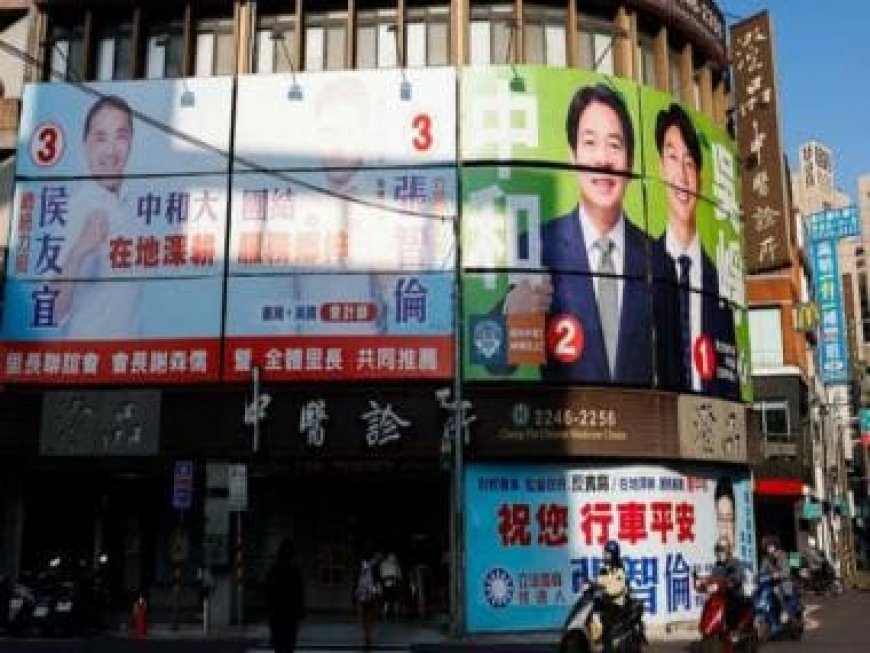
According to two senior government officials, Taiwan’s administration anticipates that China would try to exert pressure on its future president following Saturday’s elections by, among other things, conducting military drills close to the island this spring.
According to Taiwanese officials who briefed reporters under condition of anonymity, Beijing’s military and economic pressure on Taiwan’s future leader is certain to rise regardless of which candidate wins the election.
Under the watchful eye of a more assertive China, which has declared the election a choice between “peace and war,” Taiwan will cast ballots to choose a new parliament and president.
China and the Kuomintang (KMT), Taiwan’s main opposition party, issued a warning on Thursday over the threat to peace that Lai Ching-te, the presidential candidate of the ruling Democratic Progressive Party (DPP), would represent if he is elected. If elected, Lai has promised to work toward peace and communicate with China.
According to one official with knowledge of Taiwan’s security preparations, Beijing is likely to exert “great pressure” in an attempt to sway the incoming president’s inauguration speech on May 20, which is anticipated to set the tone for the new administration’s China policy.
Despite the adamant protests of the Taipei government, China maintains that democratically run Taiwan is its territory and has never given up using force to annex the island.
According to the official, who cited Taiwan’s security assessment, Beijing is expected to conduct maneuvers close to Taiwan after March owing to better weather and sea conditions, even though extensive military exercises are unlikely to take place right after the vote.
Washington and its allies, as well as the people in the region, are keenly monitoring the possibility of increased tensions over Taiwan, particularly in light of China’s two large war drills that were held close to the island in April of last year and August of 2022.
Speaking under anonymity because they were not permitted to address the media, two Western security officials predicted that China would use force after the election, though they did not think it would be as extensive as the previous time.
According to the Taiwanese official, Beijing may decide to curtail any military demonstrations in the upcoming months due to many factors, such as bettering relations between the United States and China.
The relationship between the US and China reached all-time lows last year, but after meeting in November and agreeing to reestablish military-to-military contacts, top US and Chinese officials have arranged meetings.
China is likely to refer to the newly elected government as a “minority government” if the winning party is unable to secure a legislative majority, according to Taiwanese officials.
China has not declared its favored candidate in public, but it has urged Taiwanese voters to make “the right choice” after labeling a DPP vote as risky and endangering cross-Strait harmony. Despite its denials, the KMT has historically supported tight relations with China.
The defense ministry of Taiwan reported on Friday that it had seen five Chinese balloons flying over the Taiwan Strait in the previous 24 hours, one of which had crossed the island. This is just the most recent in a string of balloons of this type that the government claims it has seen in the previous month.
China’s balloon flights, allegations by its official media, and threats of more economic penalties, among other activities, have all been regarded by Taiwan as psychological warfare against the people of the island before to the vote.
(With agency inputs)
What's Your Reaction?